970 SMBs, 12 months of AI on the phone: yourang.ai report
Cet article n'est disponible qu'en anglais.
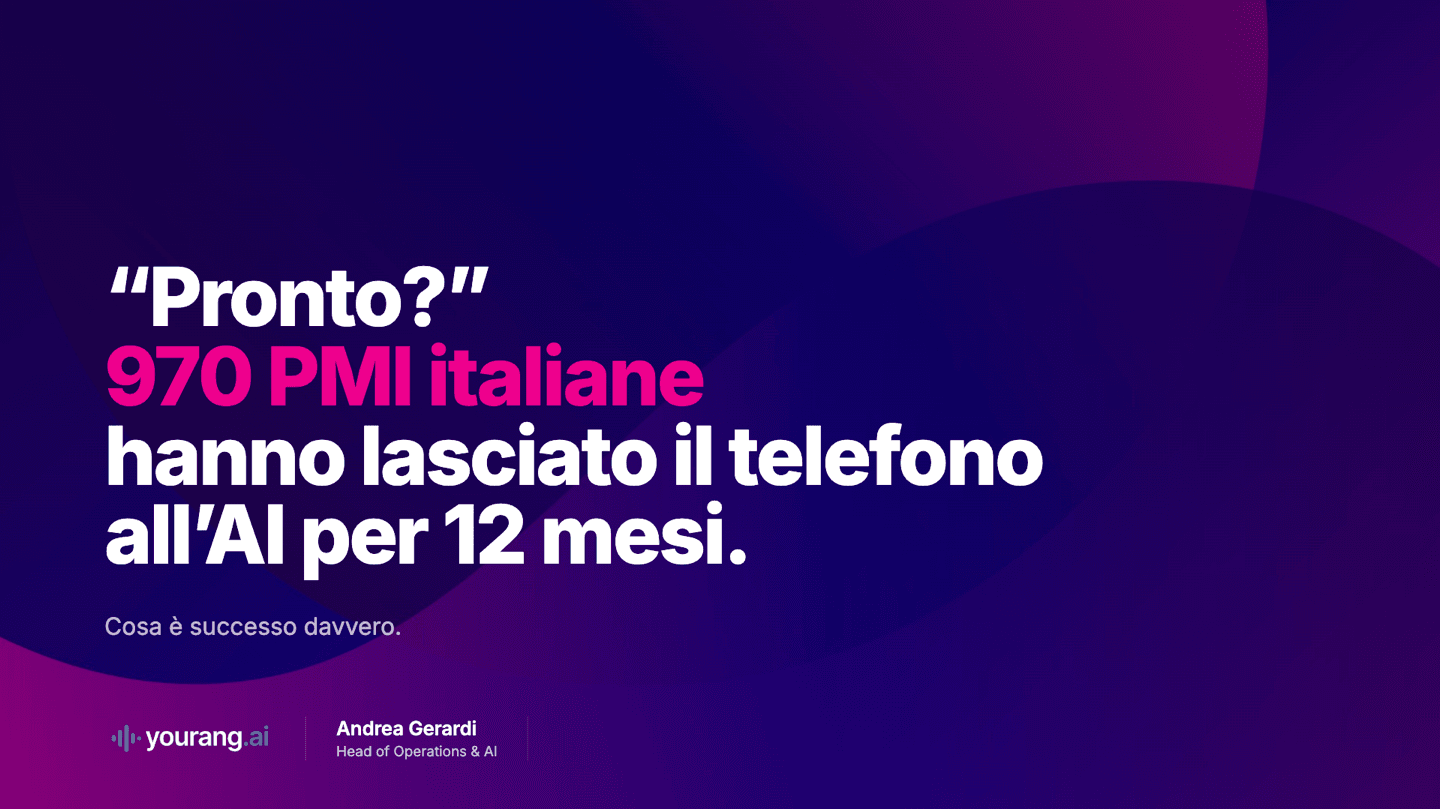
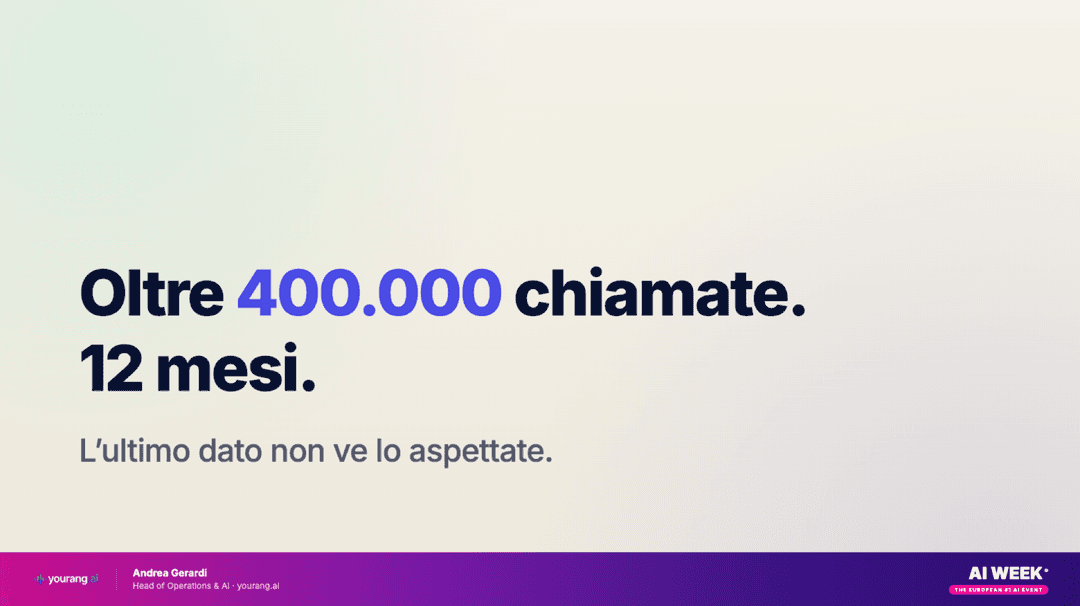
For 12 months, 970 Italian small and medium-sized businesses handed their phone to a yourang.ai AI assistant, which handled more than 400,000 calls over that period. These are the numbers presented by Andrea Gerardi, Head of Operations & AI at yourang.ai, in the talk “Pronto?” (“Hello?”) at AI Week 2026 in Milan on 20 May 2026. This article brings them together in one place, with context on missed calls and an honest section on what the methodology does and does not tell us.
Key numbers at a glance
- 970 Italian SMBs used a yourang.ai AI phone assistant for 12 months.
- Over that period the assistants handled more than 400,000 calls.
- On average that is about 412 calls per business per year, or about 34 a month: this is our own calculation (400,000 divided by 970), not a figure from the talk.
- The work covered inbound calls, lead qualification, appointments and after-sales, according to the official description of the talk.
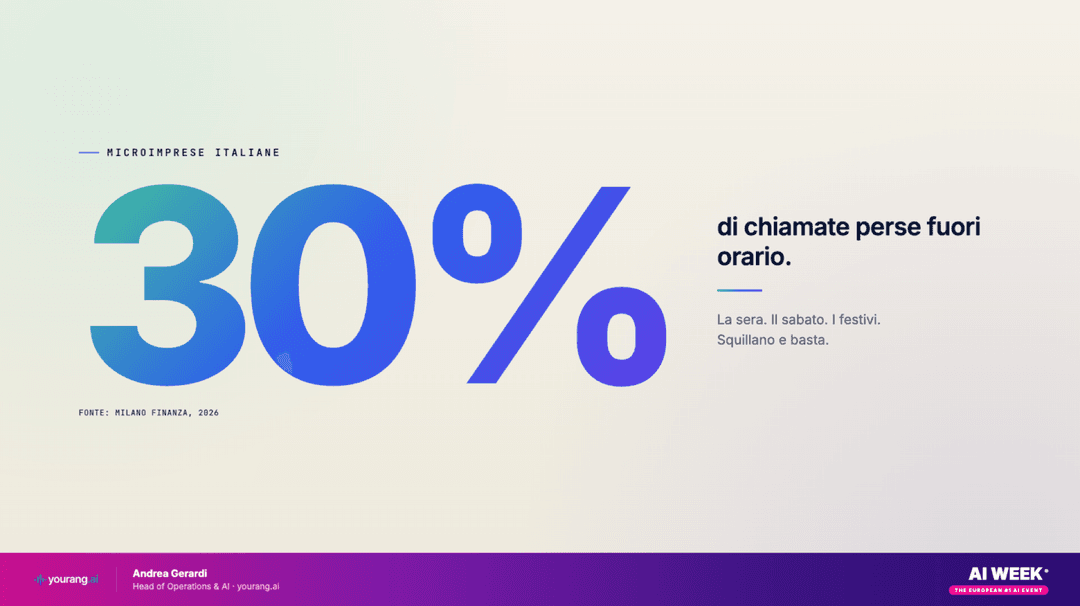
- For context, at Italian micro-businesses out-of-hours missed calls can reach 30% of the total, according to estimates reported by Milano Finanza (January 2026).
| Indicator | Value | Source |
|---|---|---|
| Businesses involved | 970 Italian SMBs | yourang.ai talk at AI Week 2026 (20 May 2026) |
| Observation period | 12 months | yourang.ai talk at AI Week 2026 |
| Calls handled | Over 400,000 | yourang.ai talk at AI Week 2026 |
| Average per business | About 412 calls a year (about 34 a month) | Our calculation from the two figures above |
| Out-of-hours missed calls at micro-businesses | Up to 30% of the total | Estimates quoted by Milano Finanza, 29 January 2026 |
Where the data comes from
The numbers come from the talk “Pronto? 970 PMI italiane hanno lasciato il telefono all'AI per 12 mesi. Cosa è successo davvero.” (“Hello? 970 Italian SMBs handed their phone to AI for 12 months. What really happened.”), given by Andrea Gerardi on Standup Stage 1 at AI Week 2026 in Milan on 20 May 2026. A recording of the talk, in Italian, is available on YouTube.
The presentation describes the scope as follows: for 12 months, AI phone assistants handled sales and customer care for Italian SMBs, dealing with dialects, wary callers and angry customers. Four types of work are mentioned: inbound calls, lead qualification, appointments and after-sales.
Methodology: what we know and what we don't
A number is only useful if you know how it was measured. So we separate explicitly what has been published from what has not.
What is documented:
- the sample: 970 Italian SMBs that used yourang.ai AI phone assistants;
- the duration: 12 months;
- the volume: more than 400,000 calls handled;
- the types of work: inbound calls, lead qualification, appointments, after-sales.
What is not publicly documented as of today:
- the exact start and end dates of the 12 months;
- whether all 970 businesses were active for the whole period or only part of it;
- the definition of a “handled call” (for example whether it includes very short calls, outbound calls or calls transferred to a person);
- the breakdown by sector, company size and region;
- call outcomes: how many ended with an appointment, information given or a transfer;
- the average length of conversations.
That is why we are not publishing a table by sector or success rates: we don't want to turn into “data” something that has not been measured and described in a verifiable way. When the full methodology is published, we will update this article and the update date at the top.
The context: how many calls small businesses miss
The problem behind the talk is simple: in a small business the phone rings even when nobody can answer. In the evening, on Saturdays, on public holidays, or simply when whoever is working has their hands full.
In an article of 29 January 2026 about AI assistants answering business phones, Milano Finanza reports that, according to some estimates, out-of-hours missed calls reach up to 30% of all calls at micro-businesses. Treat this as an order of magnitude: the article does not name the primary source of the estimate.
The same article also reports figures on AI adoption: Italian companies with at least ten employees using AI technologies rose from 5% in 2023 to 16.4% in 2025, and the gap between large companies and SMBs remains wide (53% versus 15.7%). Again according to the article, lack of in-house skills is cited by 60% of companies that considered an AI investment but did not go ahead.
What these numbers mean for a small business
An average of about 34 calls a month per business says something important: the sample is mostly made up of businesses where the phone matters but that are not call centers. Professional practices, shops, small hospitality businesses, service companies: places where every missed call may be a customer calling a competitor. It remains an average, though: without the distribution we cannot tell how many businesses get far more calls and how many far fewer.
For these businesses the point is not replacing people, but covering the gaps:
- out of hours, when nobody answers and callers rarely try again;
- during peaks, when two calls come in at once;
- while working, when answering would mean interrupting a customer in front of you.
If you want to estimate what missed calls cost you, our article on how much an AI phone assistant costs includes a simple method to run the numbers.
Themes of the talk: what matters on the phone
The talk's description highlights three themes, which are also useful if you are evaluating a phone assistant:
- real speech: dialects, accents, broken sentences. A phone assistant has to understand how people actually speak, not how they write;
- wariness: some people do not trust talking to an AI. Introducing itself clearly as an AI assistant, as the EU AI Act also requires, and getting straight to the point reduces friction;
- angry customers: recognising tone and knowing when to pass the call to a person is part of the job, not an exception.
The talk also promises to cover the mistakes that drive a customer away at the first “hello”. Without anticipating its content, the most common ones are familiar to anyone who has called a business: an opening that goes on too long, pointless questions before understanding the request, and no way to reach a person when it matters.
Questions we want future reports to answer
A useful report grows over time. These are the questions we would like to answer in future editions, with a documented methodology:
- When do calls come in? How many fall outside opening hours, in the evening, at weekends and on public holidays.
- How does it vary by sector? Medical practices, restaurants, hospitality, retail and services have very different rhythms and requests.
- How do calls end? How many close with an appointment, with information, with a transfer to a person or with a message.
- How long do they last? Average length and distribution, to understand how much work is actually taken off people.
- What do customers ask? The most frequent requests, useful to anyone preparing an assistant or even just an FAQ page.
When this data is available with stated period, sample and definitions, we will publish it here and update the date at the top.
How to cite this report
If you quote these figures, please present them for what they are: numbers presented by yourang.ai at AI Week 2026 about its own customer base, with the methodological limits described above. The 30% out-of-hours missed-call figure, by contrast, is an estimate reported by Milano Finanza.
Want to see how it would work for your business? Visit the AI phone assistant page, compare the plans on the pricing page or book a demo and listen to a call on a case like yours.
Questions fréquentes
How many SMBs used an AI phone assistant in the yourang.ai report?
970 Italian SMBs handed their phone to a yourang.ai AI assistant for 12 months. The figure was presented by Andrea Gerardi, Head of Operations & AI at yourang.ai, at AI Week 2026 in Milan.
How many calls were handled?
Over 400,000 calls in 12 months. On average that is about 412 calls per business per year, a little over one a day: a simple average we calculated by dividing the two numbers, since the actual distribution across businesses has not been published.
How many calls do micro-businesses miss outside opening hours?
According to estimates reported by Milano Finanza in January 2026, out-of-hours missed calls can reach 30% of all calls at Italian micro-businesses. The article refers to “some estimates” without naming the primary source.
Is the report's methodology published?
Not in full. The number of businesses, the length of the period and the call volume are known. Exact dates, the definition of a handled call, the breakdown by sector and call outcomes have not been published.
Where can I watch the presentation?
The talk (in Italian), “Pronto? 970 PMI italiane hanno lasciato il telefono all'AI per 12 mesi. Cosa è successo davvero.”, is available on YouTube; the full deck can be requested from yourang.ai.