Gemini 4 Carbon: what it is, benchmarks, what it means
Dieser Artikel ist nur auf Englisch verfügbar.
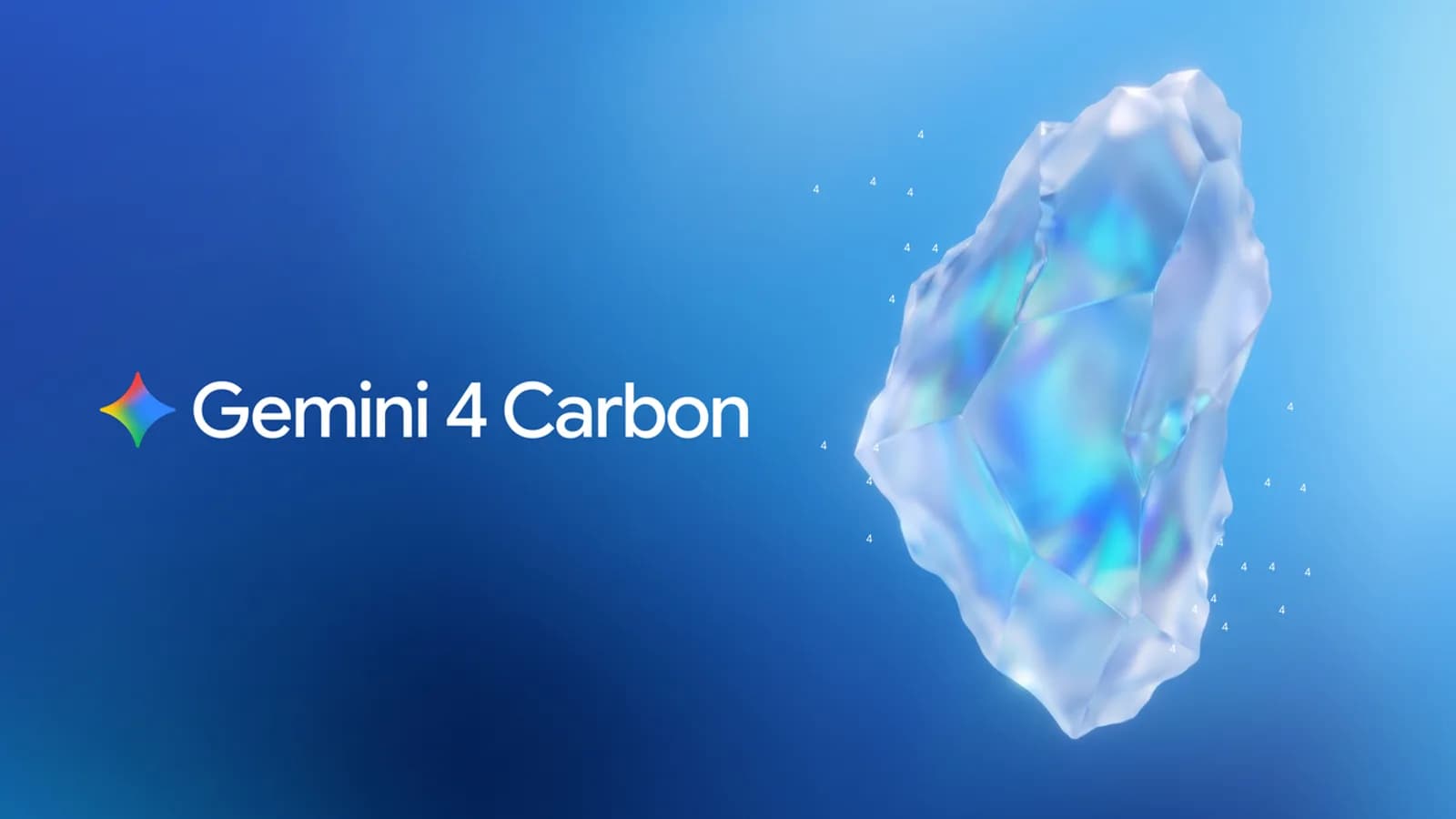
Gemini 4 Carbon is Google's new flagship model, announced on 28 October 2026. It has been available to developers and businesses since 10 November and is reaching Google AI subscribers in stages. It is not a voice model. If you run an AI phone assistant, nothing changes tomorrow morning. Two figures in the announcement, though, matter to anyone who lets an AI talk to their customers: Carbon makes about half as many unsupported claims as its predecessor, and on the Gray Swan benchmark, as measured by Google, not a single attempt to manipulate it with hidden instructions succeeded.
Here is what was announced, what the benchmarks say and what to ask the provider of your AI phone assistant.
Update, 10 November: Carbon is available
On 10 November Google opened Gemini 4 Carbon to everyone, two weeks after the announcement:
- developers and enterprises can use it through the Gemini API in Google AI Studio on a paid plan;
- Google AI Ultra subscribers are getting it in the Gemini app, AI Mode in Search and Google Antigravity;
- Google AI Pro subscribers have had it in AI Mode since 15 November, as Rajan Patel, Google's VP of Engineering for Search, confirmed on X (Search Engine Roundtable, 16 November);
- scientists and cybersecurity specialists can apply for dedicated access, granted by eligibility and capacity.
Google itself recommends Argon for most knowledge and software work, and Carbon for the hardest, most token-hungry tasks. For AI on the phone, what we wrote below still holds: Carbon is a text model, not a real-time voice model.
Update, 19 November: no longer first in the rankings
At launch Carbon topped the Artificial Analysis Intelligence Index, the most quoted independent ranking. Since 9 November it has been overtaken by Anthropic's Claude Fable 5.2, then by OpenAI's GPT-6.2 Astra on 17 November and by Gemini 4 Neon, another Google model, on 18 November. On 19 November the model leaderboard, which lists each model at its best setting, gives Fable 5.2 a 65, GPT-6.2 Astra 62, Neon 61 and Carbon 60 (59 in Google's launch table).
Neon does not replace Carbon. In Google's announcement Carbon remains the model for the hardest, longest projects and Hydrogen the one for fast everyday work; Neon sits in between, with a stated 32% lower cost per task than Carbon. It is available in the Gemini API, in Gemini for business and, for Google AI Pro and Ultra subscribers, in the Gemini app and in Antigravity. Like Carbon, it is not a real-time voice model: in the announcement audio only appears among the files it can analyse.
What Google announced
In the launch post on blog.google, Koray Kavukcuoglu of Google DeepMind describes Carbon as "our strongest model", with leading results in cybersecurity and long-horizon work. The key points:
- Four weeks after Argon. Gemini 4 Argon was announced on 30 September; Carbon builds on it and improves coding, agentic and scientific tasks, and understanding of images and documents.
- Tasks that run for days. Google says its internal teams have seen Carbon work for days on complex jobs, such as tracing the root cause of a bug in a large codebase and patching it.
- Security first. Carbon is built to find, validate and fix software vulnerabilities, which is where Google reports its strongest results.
- Gradual access. At launch it went to a subset of cyber defenders. Access was then to expand to other trusted partners through the Fairwind Program and, later, to developers, businesses and consumers. On 10 November Google opened it to everyone (see the update above).
Argon has been generally available to developers since 13 October according to the Gemini API changelog; Carbon since 10 November.
Carbon vs Argon
| Gemini 4 Argon | Gemini 4 Carbon | |
|---|---|---|
| Announced | 30 September 2026 | 28 October 2026 |
| Availability | all developers since 13 October; in the Gemini app for Google AI Pro and Ultra subscribers | since 10 November for developers and enterprises on the paid Gemini API; rolling out to Google AI Ultra subscribers (Gemini app and AI Mode) and, in AI Mode, to Pro subscribers since 15 November |
| Stated strength | office work, automation, very long documents | cybersecurity, long multi-step tasks |
| Artificial Analysis Intelligence Index v5.0 | 50 | 59 (first on 30 October; on 19 November Claude Fable 5.2, GPT-6.2 Astra and Gemini 4 Neon are ahead) |
| Unsupported claims (Google internal testing) | baseline | about half |
Sources: blog.google and the Google DeepMind Gemini page, accessed 30 October 2026.
The benchmarks Google published
Benchmarks are standardised tests: the same set of tasks is given to different models and the results are compared. Below is a selection from the table published by Google DeepMind. None of these tests measures a phone call.
Gemini 4 Carbon compared: benchmarks reported by Google
Benchmark What it measures Gemini 4 Carbon Gemini 4 Argon GPT-6 Astra Claude Opus 5.5 AA Intelligence Index v5.0 general capability (Artificial Analysis index) 59 50 57 58 Vals Index v2.2 economically valuable office work 70.4% 69.2% 65.0% 70.2% AutomationBench business process automation 53.9% 51.3% 41.4% 42.5% Terminal-Bench 4.0 command-line work 65.2% 57.1% 59.1% 59.6% FrontierSWE 2 advanced software engineering 61.2% 55.0% 65.5% 62.3% Agents' Last Exam v1.1 computer use as an agent 77.4% 69.0% 73.1% 71.6% OSWorld-2.1 (offline) computer use as an agent 81.5% 74.7% 80.9% 87.2% GraphWalks 256k–1M (F1) reasoning over very long inputs 96.2% 84.2% 71.8% 66.8% CWE-bench patching vulnerabilities 71.0% 68.0% 68.0% 67.0% SEC-bench Pro finding vulnerabilities 88.2% 83.4% 85.4% — Best result in each row in bold. Source: Google DeepMind, Gemini page, Performance section, accessed 30 October 2026. Methodology: deepmind.google/models/evals-methodology/gemini-4-carbon. A dash means no value was reported.
Three caveats:
- These are the vendor's numbers. Google ran the cybersecurity tests without safety filters, and for competitors it partly relies on figures published by others. Independent checks will come once the model opens up.
- Carbon doesn't win everywhere. In the full table (17 rows) it leads 15 tests: it trails GPT-6 Astra on advanced software engineering (FrontierSWE 2) and Claude Opus 5.5 on computer use (OSWorld-2.1). On 9 November Anthropic published its own comparison: on AutomationBench Carbon (53.9%) also beats Claude Fable 5.2 (51.4%), by Anthropic's figures.
- The biggest jump is on very long inputs: on GraphWalks it goes from Argon's 84.2% to 96.2%. That is the kind of gain an agent needs to work for a long time without losing track.
The figure that matters on the phone
The most useful part of the announcement for a business is not the table but the section on reliability. According to Google's internal testing, compared with Argon, Carbon:
- makes about half as many unsupported claims, meaning answers given with confidence but not backed by the information available;
- overreaches 26% less and under-delivers 29% less, two failure modes Google links to errors in multi-step work;
- resists hidden instructions better. On Gray Swan's indirect prompt injection benchmark, which plants malicious instructions in the content a model reads, the attack success rate drops from Argon's 0.7% to 0.0%.
On the phone, these are exactly the failures that cause damage. An assistant that makes up your opening hours, confirms a service you don't offer or promises a call-back nobody will make creates a problem you then have to fix. And an assistant connected to a calendar, CRM or inbox reads text written by other people: notes, messages, web pages. Resistance to hidden instructions is what stops one of those texts from making it do something it shouldn't.
Why it isn't a voice model
Carbon's announcement says nothing about audio, voice or real-time conversation. For voice Google has a dedicated family of models, Gemini 3.8 Live, introduced on 15 September 2026 and built to answer in a fraction of a second, cope with callers who talk over it and take actions while the conversation goes on.
It's the same pattern we saw with Grok Voice 3.0 and GPT-Live-1.1: flagship models handle long, complex work, voice models handle the call. Over time the gains of the former reach the latter, and that is where a business will notice them: fewer calls ending with "we'll call you back", fewer wrong answers, more requests settled in a single call.
Questions to ask your provider
For a restaurant, a medical practice or a professional firm, the Carbon announcement is a good excuse to check the assistant you have, or the one you are considering:
- What happens when it doesn't know the answer? Make a test call with a question it can't answer: it should say so and offer a next step, not make something up.
- Where does its information come from? Opening hours, services, prices and rules should come from what you configured.
- What does it read from outside? If it is connected to your calendar, CRM or inbox, ask how it is protected against instructions hidden in that content.
- Which voice models does it use, and how are they updated? A good provider switches models when a better one comes out for its use case, without making you redo the setup.
- What can it do during the call? Booking appointments, logging requests, sending a summary: features and integrations matter more than scores.
- Does it hand the call to a person when needed, and say up front that it is an AI, as the AI Act requires?
For a comparison of the options available in Italy, see our guide to the best AI phone assistants of 2026.
In short
Gemini 4 Carbon is Google's strongest model, second only to Claude Fable 5.2 on the Artificial Analysis index, available since 10 November but not built for voice. For anyone using AI on the phone, the real news is the direction: models that make things up less and are harder to manipulate. An assistant should still be judged on real calls. If you want to hear how an AI phone assistant would answer for your business, book a demo.
Häufige Fragen
What is Gemini 4 Carbon?
It is Google's new flagship model, announced on 28 October 2026. Google calls it its strongest model, built for cybersecurity and for long, multi-step work such as finding and fixing a bug in a large codebase.
Can I use Gemini 4 Carbon yet?
Yes, since 10 November 2026. Google opened it to developers and enterprises on a paid Gemini API plan, in Google AI Studio, and is rolling it out to Google AI Ultra subscribers in the Gemini app and AI Mode in Search; since 15 November Google AI Pro subscribers also get it in AI Mode. For the first two weeks only a few cyber defenders in the Fairwind Program had it.
How is Gemini 4 Carbon different from Gemini 4 Argon?
Argon was announced on 30 September and has been generally available to developers since 13 October. Carbon arrives four weeks later, scores higher on most of the tests Google published and, according to Google's internal testing, makes about half as many unsupported claims.
Is Gemini 4 Carbon the best model on every benchmark?
No. In Google's table it leads 15 of 17 tests, but trails GPT-6 Astra on FrontierSWE 2 and Claude Opus 5.5 on OSWorld-2.1. These are figures published by the vendor.
Will an AI phone assistant get better with Gemini 4 Carbon?
Not automatically. Carbon is not a real-time voice model: for phone conversations Google offers the Gemini 3.8 Live models. What matters in the announcement is the direction: fewer made-up answers and stronger resistance to instructions hidden in content.